A ministry newsletter or bulletin for your volunteers is a great way to maintain good communication, to encourage and inspire your team. Excitement and enthusiasm is catching and this is a great way to share the excitement of what's happening in your kids' ministry, while making sure that everyone is on the same page. Now, you can prepare and produce a monthly newsletter in less than no time at all. Purchase a subscription for Group's 'Be Awesome' newsletter and most of your work is done. Each month you'll be sent a link to download the 4-page newsletter as a Word file. Add your relevant information, upcoming events and an inspirational devotion or article and it's done. Then print off copies for your team or email the newsletter directly to them. If you need some ideas for inspirational content or training to include in your newsletters, take a look at ' Training on the Go,' or ' 2-Minute Encouragers for Teachers'. Each 4-page issue of Be Awesome includes: A relevant article. Customizable content areas for you to include updates for your team. Calendar where you can add events, meetings—whatever you want! Download a free sample ... here | | | You might also be interested in: | | | |
The devastating tornado in Oklahoma and the magnitude of this disaster has generated world-wide attention. Even here on the Gold Coast, it has received front-page newspaper coverage. Our thoughts and prayers are with this community as they deal with the heart-breaking destruction and loss. The Skit Guys have responded to this tragedy with the offer of a free clip, 'The Storms of Life', in the hope that you can download and use this to encourage discussion about this and other tragedies. (see below) "We hope that your church community will remember ours. Remember that there’s a community aching. Remember there’s a lot to rebuild––both homes and hearts. Please keep OK in your prayers today and in the weeks to come.' Skit Guys In Australia, natural disasters are common: drought, cyclones, fire, floods. The predictability of these disasters has been immortalized in the imagery of our poetry and literature, but are you and your children's ministry team prepared for it? Can you comfort families and children and help them cope with disaster? There are a number of points to keep in mind. 1. Children need physical reassurance. They need to be with their family to feel safe. Keep in mind that displaced children will require even more physical comforting. 2. Children need to talk. Listen to them. They need to know others understand and share their worries and concerns. 3. Talk honestly.... but don't scare them. Share worries in an age-appropriate manner. 4. Remain as calm as possible. Maintain normal routines as much as you are able. 5. Expect regressive behaviour. Generally, such behaviours will fade over time. More helpful information can be found from the following resources:
Some time ago, Elevate at Church launched a program for families- Elevate at Home. The idea was to make their Sunday morning kids ministry program materials available for families to download and use at home to develop and grow leaders: making good kids into great leaders. I don't know if you accessed their materials and promoted them with your church families but the quality of animated Bible stories and lesson materials is excellent. Now, they have revamped the program and are offering the resources to families on a subscription basis- $3.99 per month. It's great value and well presented. The other positive feature of this new approach is that you don't have to download the clips. The new improved website allows kids and families to watch any lesson movie at any time using any device. It's worth taking some time to check it out- here! Mike Johnson, children's pastor and executive producer says: "This new and improved, streaming website takes the stories (lessons) from the Bible and brings to light the leadership principles that are contained within them. From the lesson of Gideon we can learn about confidence. From the lesson of Nehemiah we can learn about perseverance. From the lessons of Paul we can learn about commitment, and the list goes on. This program gets kids into God’s Word during the week so that it can be learned and applied to their lives now, and in the future. Our world needs, and will need, men and women who will step up and lead our world in a God honoring way. That’s why you and I have given our lives to work with kids - to teach them God’s Word today so they can impact their world now, and the larger world tomorrow".
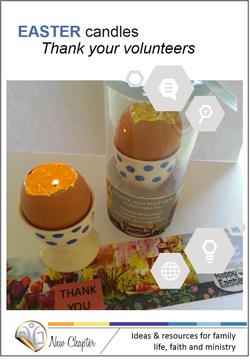
If you're looking for a 'thank you' gift for your volunteers and leaders that is a little more meaningful than an Easter egg or a box of chocolates, then this simple egg candle may be useful- it's very easy to make. Then package it up with some plastic film and add a 'thank you' label'.
Instructions: 1. Carefully cut the top off an egg and remove the egg. Rinse and dry. 2. Add a candle wick inside the empty egg shell and fill with candle gel. (The gel candle kits are readily available from most toy shops and contain the candle wicks and gel.) 3. Pop the egg shell candle in an egg cup. 4. Cut out 2 x 6cm diameter circles of styrofoam or corrugated cardboard 5. Cut a piece of clear plastic film 15cm x 21cm. (OHP transparency film would be fine.) 6. Place the egg cup with candle on one of the styrofoam circles. 7. Form a cylinder by wrapping the plastic film around the styrofoam circle and eggcup and secure with clear tape. 8. Attach the other styrofoam circle at the top of the cylinder. 9. Print the label. (see below) 10. Cut out and wrap around the base of the cylinder with eggcup. 11. Add a ribbon bow to the top of the cylinder, if required.
 | easter_candle_label.pdf | | File Size: | 376 kb | | File Type: | pdf | Download File
Motivation is when your vision puts on work clothes. I really wish I had an amazing formula to generate continuous energy and enthusiasm for the challenging work of children's ministry. Let's face it- the work is constant, demanding and endless. Special events and programs are rewarding but exhausting, and preparations for regular mid-week and Sunday programs still continue. So..what happens when your motivation wanes and enthusiasm dips?Make sure that you are maintaining your time with God and His Word and your prayertime. Ensure you are allowing yourself some downtime, some time for yourself. Don't fill every waking moment with activity. As a leader, you must ensure that you are spiritually, emotionally, mentally and physically replenished. You need to fill your own tank before you can effectively give to others! KidsKount produce some bite-sized (2 minute) video segments to help you do just that... Lead yourself! It's worth checking out..But it's also helpful to keep in mind that energy and enthusiasm is not required before you start working. In fact, hard work comes before the feeling of enthusiasm. Motivation is largely a myth.. it's activity that inspires us. Don't waste time waiting for enthusiasm to return; work harder even it you don't feel like it. You'll find your motivation returns as you accomplish those tasks you've set yourself. Stay faithful to the work God has given to you to do. And, praise Him as soon as your motivation catches up. I don't sing because I'm happy. I'm happy because I sing. | We overestimate what we can do in the next year... and underestimate what we can do in the next 15 minutes. But, on a practical note, there are some things you can do that will help you complete your tasks: 1. Exercise. 15 minutes a day exercise will help you have more energy and be more productive. 2. Many find it helpful, sometimes, to work away from the usual working environment. Go to the library.. spend the morning at a coffee shop. 3. Play some background music. 4. Make use of the many task management programs and apps to keep focused. I've listed some of the popular ones below: * Wunderlist: simple to-do lists, works on all platforms, tasks can be shared, create tasks from email * Toodledo: powerful task and note-taker app, add reminders, repeats, alarms, add to folders, filter, tag and tweet your completed tasks * Astrid: cloud sync, voice recognition, share tasks, email intergration, add to calendar * Remember the milk. Simple list creation, available across platforms * Priorities. Create tasks and sub-tasks, lists, calendar integration, templates, repeating tasks, |
Children's Ministry coordinators, directors and leaders often bemoan the mountain of admin that accompanies children's ministry, and it's true, especially if there are multiple age-groups and midweek programs involved.
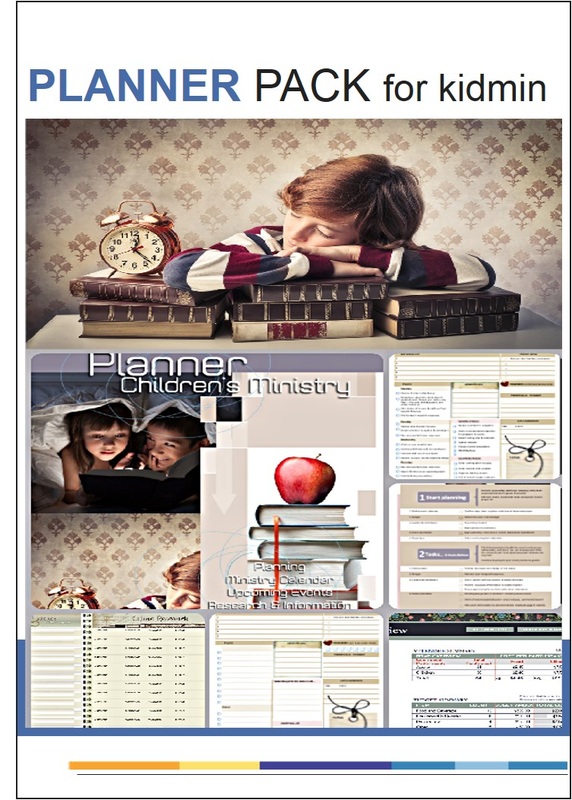
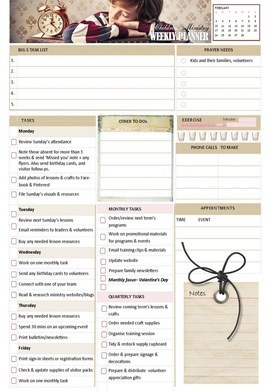
It's so easy to feel overwhelmed by the seemingly endless and mundane tasks. But if you take just a couple of these tasks each day you'll find that you can regain your balance and focus. To assist with this, I've included a weekly ministry planner with weekly tasks and monthly/term tasks to help you sort out your workload.( Simply download and print the copies you need- one for each week.) The download also includes some added details and ideas for some of the listed tasks and suggestions for the month's focus.
Hopefully, this will be part of a planning collection filled with helpful forms and planning templates designed specifically for the admin needs of children's ministry leaders. Coming soon...
 | childrens_ministry_planner.pdf | | File Size: | 1065 kb | | File Type: | pdf | Download File
Earlier this week, we were flooded in. The aftermath of ex-cyclone Oswald caused wide-spread flooding to a large part of south-east Queensland and although our home was high and dry, we were certainly affected. Roads were impassable, electricity was cut, phone and internet coverage was down. I had no way of contacting my family and no way of determining their safety, circumstances or needs. I was totally isolated.
If you work in children's ministry you can not function in isolation.You need to connect with others- your church families and the community, your team and a wider ministry network. You need to develop 'Relationships', the second element of our F.R.E.S.H. approach to children's ministry. Building relationships is an integral part of a thriving ministry. So.. how do you go about it? Check out these 3 areas and click through to the practical suggestions and ideas. Community. - Communicate often through church announcements, bulletins and flyers.
- Update the church family following a special event. (We produce a short clip of photo highlights using SmileBox or Animoto.)
- Provide information about your ministry prayer needs.
- Upload photos of lessons & crafts to your ministry Pinterest boards and Facebook page.
- Send news releases about events to the local/community newspaper.
- Provide regular newsletters to families ..see here
| Team. Don't do it alone. - Develop teams in your ministry to share the load, to encourage and support each other.
- Take time to discover your leaders/volunteers' strengths and skills.
- Have fun! If you and your leaders are enjoying ministry, so will the kids.. and parents will notice.
- Develop a circle of key leaders for each department or group.
- Encourage key leaders to connect with those in their group.
- Encourage leaders to connect & encourage parents.
- Equip your team. Schedule training and resourcing. Try email training.. see here
- Make training fun! include inspirational content with practical hands-on skills- teach face-painting, balloon sculpture, puppetry, photography...
- Involve in other ways those who cannot be actively participating: sending birthday cards to kids, prayer, website updates, buying supplies, emailing roster reminders, painting backdrops.
- Share inspiring stories.
| Network. - Join a children's ministry network in your area. It's a great way to encourage other leaders and share skills, information & ideas
- Start one, if none exists.
- If all else fails, look at an online group.
- Connect with your senior pastor and/or church leadership. Meet once a month to share what's happening with families and ensure your ministry is in line with the direction your church is heading.
- Develop a link with other church ministries. Develop a link with youth ministry and leadership programs. Ask the seniors' group to share their skills with midweek programs. Highlight Grandparents' Day with kids and the church family.
|
| | While every children's ministry coordinator is aware of the need to maintain good communication with their team, individuals and families, it is much harder to put this into practice. It's time-consuming- working out your content, ensuring you've included all relevant information, maintaining all your contact details. And, you want any message to be well-presented; to stand out from the sheer volume of information most people receive daily, and catch the attention of the recipient. High Impact eMail app may be well worth investigating. This app provides quality email templates for any occasion- casual messages, newsletters, announcements, events- that are easily customised for your individual use. You can add your own images, alter template text, insert links and more. You can also create an unlimited number of email groups straight from your iPad contacts list or add the information manually. And, you can set up your own profile with logo and contact information to be included automatically in your emails. Once you have sent your email, share it easily on Facebook and Twitter. Check out here for more information. |
The start of a new year brings its own excitement and challenges: the anticipation of seeing anew God working in the lives of children, families and volunteers, with new ideas and exciting programs to launch and new opportunities to glimpse the wonder of little ones learning about our great and loving God. But, there are also the difficulties of working in a ministry area that is time and labour intensive, the ever-present admin tasks, the danger of becoming over-stressed, exhausted, of feeling over-whelmed and left gasping for air. This year, start with a F.R.E.S.H. approach to your children's ministry. Over the next few posts, I'll highlight five aspects of your ministry and provide you with some practical strategies. Establishing some simple but sustaining tools will equip you to handle the pressures and demands of ministry. Finally, in conclusion to this series of posts, I hope to complete and provide you with some practical worksheets to assist in your planning and organisation. But first..... 1. FOCUS. Make sure that you begin this year with a clear and concrete understanding of both your role and your vision. Many children's ministry directors or coordinators find themselves in a role that has developed apace with their growing ministry. Now, while this is understandable, there are clearly some concerns here. A children's ministry director may discover that there are unspoken expectations of them that are beyond their capabilities in both time and resources. A job description is a necessity. If you don't have one, ask for one and if you have one, read it carefully and ask for clarification if you're at all uncertain about any aspects of your role. A job description ensures that both you and the church leadership are clear about your role and your responsibilities. It also means that you can sensibly plan and structure your time and commitments in alignment with your role. Your job description will probably begin with a definition similar to the following: ' The Children's Ministry director/coordinator is responsible for overseeing all aspects of a growing children’s ministry and to ensure a smooth operating, safe and effective program. The director will recruit and train leaders and teachers who will touch children’s lives with God’s love and teach them God’s Word while laying a spiritual foundation for their relationship with Christ and teaching them to serve within the church. The director will also be a spiritual leader to those working in this ministry and provide training and encouragement to parents, equipping them to be the primary spiritual leader of their children.' It can seem a little daunting, but don't panic. Following this, you should find a list of practical expectations. Read it all carefully as this will provide you with helpful assistance in your planning and preparation. It provides you with the information you need to determine your specific areas of responsibility for children, families, volunteers and wider church family. But you also need to focus on your ministry vision. Do you have one? Is it clear to everyone? Is it included in all your ministry materials? Your ministry vision provides a yardstick for current and future ministry programs and outreach? Are these in alignment with our vision and focus? Then, they can be grow and developed. If not, it may be something that other ministry leaders would like to pursue. Do your leaders and volunteers know and share the ministry vision? Do your volunteers and leaders have a strong sense of purpose and direction? Not sure? Take this quiz from Children's Ministry to find out. Here...Then, take some time to read further: * Children's Ministry that Works! The basics and beyond. Group Overflowing with expert insights from ministry leaders. * Piece by Piece- Unlocking the puzzle for an effective ministry to today's children. Tammy Tolman Includes study questions and action steps * Making your Children's Ministry the Best Hour of Every Week. Sue Miller with David Staal Insights that can reshape your whole approach to children's ministry and cast a new vision for everyone involved.
"Sit down, Joe!" "Joe, Tyler's trying to talk at the moment. Please wait until she's finished." "Chairs are for sitting on, not climbing. Please, sit!"
Do you recognise Joe? Is Joe in your group? These kids cannot sit still or pay attention. They act on impulse, wiggle in their seats, move around a lot, talk too much or interrupt others. Studies show that about 9% of kids (9 out of every 100) will display these characteristics, and three times as many boys as girls. They are not bad or lazy or stupid. But they do require some help and encouragement to sit still, pay attention or complete a task.
So.. what do you do? Many of the programs that you use will probably include strategies that will assist these kids. Allow kids to move frequently. We rotate the kids through various activity stations every 10 minutes. We use music as a tool for transition. The different activity/learning stations employ multi-sensory strategies when presenting the activity. We also hand out something for these kids to manipulate (stress ball, paper folding, clay) when they are engaged in listening, especially during our opening and closing sessions. You can buy these squishee stress balls from toy shops and Australian Geographic or you can make you own. (You can even create these characters for a craft activity.)
You will need: *balloon *funnel (I cut a soft-drink bottle in half and use the spout end as a funnel.) *sugar, salt, sand or dried lentils *googly eyes *yarn *glue *permanent markers
Directions: 1. Insert the tip of the funnel into the balloon. Fill with sugar, salt, sand or lentils. (This is actually harder than it sounds and will take some time. If you want to do this activity with kids, you might like to fill the balloons beforehand.) 2. Tie the balloon closed. 3. Glue on googly eyes, yarn for hair 4. Draw extra details with permanent marker- nose, mouth, eyebrows
Hand these fun stress balls out to those kids that need to keep their hands occupied.
|